Photo Information

Liaison officers clear obstacles in Bangladesh disaster relief

6 Dec 2007 | Staff Sgt. Sergio Jimenez 11th Marine Expeditionary Unit

By working together liaison officers from the 11th Marine Expeditionary Unit (Special Operations Capable) Tarawa Expeditionary Strike Goup 3 and Bangladesh Army Medical Corps are making Operation Sea Angel II a success.

 This is what Maj. Faisal, who goes by his rank and name, said as he and a medical team of Marines and Sailors prepared to board a helicopter to go ashore to conduct another humanitarian mission.

 Liaison officers are representatives from the host and visiting nation who work together on issues like security, clearances, communications, logistics and medical issues, said Faisal.

 Faisal and other liaison officer are assisting medical teams, logisticians, air crew and other personnel aboard the amphibious assault ship USS Tarawa (LHA 1) and other elements of the 11th MEU (SOC), who are conducting Humanitarian Assistance/Disaster Relief efforts in the area. The humanitarian assistance was requested by the Government of Bangladesh after Tropical Cyclone Sidr struck their southern coast Nov. 15. The storm killed more than 3,000 people and has left several hundred thousand homeless. The Department of Defense effort is part of a larger United States response coordinated by the U.S. Department of State and U.S. Agency for International Development.

 Good communication, mutual respect and a sincere desire to make the lives of the people of Bangladesh better, were some of the reasons Faisal said his country’s liaison officer team has worked so well with its US counterpart.

 The last time the U.S. and Bangladesh Army liaison officers worked together was after a 1991 cyclone killed thousands of people and caused mass devastation here, said Faisal. Both nations learned valuable lessons from that experience that are paying off today.

 American technology, especially satellite weather reports have been very helpful in providing early warning of dangerous storms in the area. Good communication and the sharing of vital information like this between the liaison teams has increased the ability of both governments to react quickly to natural disasters, said Faisal.

 Aboard the Tarawa, Maj. Rezwan, said each member of the liaison team has been working closely with his counterpart to make sure every element of this amphibious humanitarian mission goes smoothly. The liaison officers tell their counterparts what the needs are on the ground and then helps coordinate with local, regional and national governments agencies and nongovernmental organizations to get help there quickly, he said.

 “Time saves lives,” said Faisal. When people are injured, sick or hungry, it’s the liaison’s job to make the calls, open doors and smooth the way to get help their fast, he said.

 During a medical team visit to Kaalapara, a small fishing village, about an hour flight away from the Bay of Bengal, the Bangladeshi liaison team guided a CH-53E Super Stallion helicopter loaded with a medical team and medicine to the village. Once there, it was obvious the team had coordinated with the local government to make sure the people were informed of the humanitarian mission and kept at a safe distance from the landing zone. Local police provided security for the team and Bangladeshi Army personnel transported the team on small military vehicles through narrow and crowded streets and delivered them to the local medical facility. Once there, the medical liaison officer arranged for a wing of the facility to be used as a treatment area by the Navy medical team.

 One of the best forms of support the liaison officers provided was as interpreters, said Navy LT. Jackie Jensen, a family physician from Fleet Surgical Team 3 temporarily attached to the Tarawa. Jensen learned from Maj. Rahman Moshiur, family physician, Bangladesh Army Medical Corps, that it is a requirement for all Bangladesh Army officers to know English and that most doctors can speak the language as well.

 At Kaalapara, doctors and medical interns from the area and others flown in from other parts of Bangladesh, helped her team overcome the language barrier.

 “Without the interpreters,” said Jensen. “It would have been impossible to communicate with our patients and provide them with good care.”


Marine Corps News

Portrait of Colonel Caleb Hyatt
Colonel Caleb Hyatt
Commanding Officer

Colonel Caleb Hyatt is a native of Tamarac, Florida. Hyatt took command of the 11th Marine Expeditionary Unit, I Marine Expeditionary Force on June 11, 2024.

Read Biography
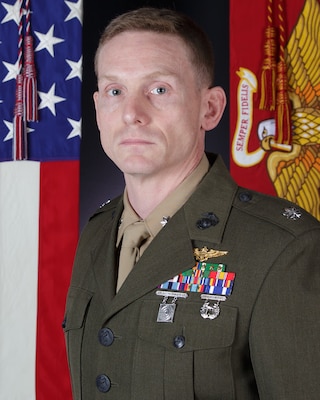
Portrait of Lieutenant Col. Christopher Scheele
Lieutenant Col. Christopher Scheele
Executive Officer

LtCol Scheele is a native of Washington D.C. LtCol Scheele is currently serving as the Executive Officer for the 11th Marine Expeditionary Unit, I Marine Expeditionary Force.

Read Biography

Portrait of Sergeant Major Janet C. Marrufo
Sergeant Major Janet C. Marrufo
Sergeant Major

Sergeant Major Marrufo reported to the 11th Marine Expeditionary Unit, I Marine Expeditionary Force in November of 2025.

Read Biography

11th Marine Expeditionary Unit